Marine davits: types and applications on workboats

Selecting a marine davit starts with defining the boat it will handle and the conditions under which the operation will take place. Boat weight and dimensions, stowage position, required outreach and the launching system all influence the characteristics of the equipment.
For a newbuild project, these parameters must also be compatible with the vessel structure and the applicable certification requirements. When replacing or modifying an existing system, the available fixing points, deck arrangement and available space may impose additional constraints. Load capacity is one of the parameters to be established, but the launching procedure, required movements and boat stowage arrangement also need to be defined.
Which davit configuration does the project require?
The type of boat and the launching system are the first factors that distinguish the available solutions. Capacity, outreach, stowage arrangement and the equipment required for the intended operations then determine the appropriate configuration.
The different alternatives have clear differences in their construction and operation.
Radial davits
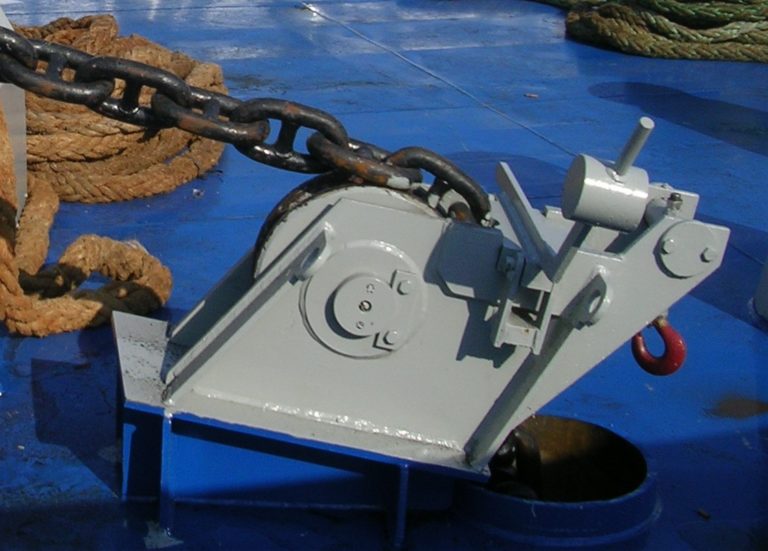
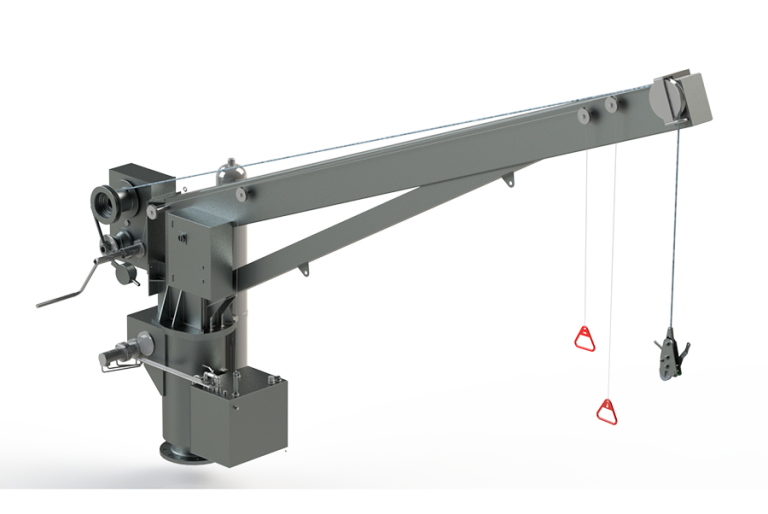
Radial davits are pedestal-type units operated by a hydraulic system. The hydraulic power unit, electrical control panel and accumulator can be integrated into the davit itself. This arrangement eliminates the need for hydraulic pipework and allows installation by bolting the davit in place and connecting the electrical power supply.
The certified range covers outreaches from 3.5 to 6 metres and safe working loads (SWL) of up to 2,200 kg. An auxiliary hydraulically driven winch can also be installed on the davit boom for provision-handling duties.
Other configurations can be considered when different outreach or capacity requirements apply.
A-frame davits
A-frame davits are commonly used for boats that are heavier and longer than conventional SOLAS rescue boats.
In this configuration, the davit structure itself serves as the boat’s stowage cradle. Depending on the project requirements, the system can incorporate constant tension, a wave-compensating shock absorber, independent console control for launching and recovery, an anti-pendulum head or a bow painter boom.
Free-fall launching ramps
Free-fall systems require a dedicated structure for launching the boat. The ramp supports the boat during stowage and forms part of the launching system.
The solution incorporates a winch and a folding gantry for boat recovery and for launching in shallow water. The gantry is operated by hydraulic cylinders fitted with braking valves.
The ramps can be supplied fully assembled, with the main hydraulic and auxiliary components installed and ready for connection to the structures provided on the vessel.
Boat and provision cranes
A combined-service crane can be used for provision handling and also as a secondary means of launching a free-fall lifeboat.
The available configurations cover outreaches from 8 to 10 metres and working loads from 3 to 6 tonnes. The crane is equipped with controls for turret rotation, boom luffing and hook hoisting and lowering.
Remote control, load cells and anemometers can also be incorporated. This solution can eliminate the need for the folding gantry used in certain free-fall launching arrangements.
Gravity davits
Gravity davits are used to launch lifeboats with a higher passenger capacity.
The boat is supported by two arms that run along separate tracks. Through a system of falls and sheaves, both arms descend simultaneously until they reach the outboard position. The boat then separates from the arms and continues its descent until launching is completed.
What needs to be specified?
Before the equipment can be defined, the characteristics of the boat and the intended operation need to be established. Relevant parameters include the boat type, its weight and dimensions, the required outreach, the safe working load (SWL) and the arrangement required for stowage and launching.
These parameters provide the basis for defining the equipment and determining whether an available configuration meets the requirements of the project.
Regulatory and certification requirements
Equipment used to launch rescue boats, liferafts, lifeboats and free-fall lifeboats must meet the applicable regulatory and certification requirements.
The equipment complies with SOLAS requirements and is certified in accordance with Directive 2014/90/EU on marine equipment (MED) and applicable IMO Circulars.
The radial davit range includes certified configurations, while other customised solutions can also be developed and certified according to project requirements.
When does a project require a customised solution?
The conditions of a particular vessel may require modifications to an existing configuration or the development of a dedicated system. Boat dimensions, outreach, stowage position or available space may require an adaptation, while the operation itself may call for specific auxiliary equipment.
In these cases, the equipment is developed around the specific project requirements, defining its capacity, geometry, actuation system and configuration.
Conclusion
Different launching solutions address different operational requirements. Their construction, capacity and operating principles need to be assessed against the boat and the conditions of each project.
Defining the boat type, its characteristics, the required outreach and the safe working load provides the basis for establishing the equipment requirements.
When a standard configuration does not meet the installation requirements, a customised design can adapt the equipment to the specific conditions of the project.
Servoship designs and manufactures customised marine equipment, with more than 50 years of experience and over 480 completed projects, including solutions for rescue boats, lifeboats and free-fall lifeboats.
Last posts
 9 de September de 2026
 2 de September de 2026
 26 de August de 2026
- 17 de August de 2026
 5 de August de 2026
 28 de July de 2026
 11 de May de 2026
 11 de May de 2026
- 11 de May de 2026
- 16 de April de 2026